
Last reviewed and updated: 2026-09-20
A water service line leak is a break in the buried pipe carrying water from your meter to the house. Everything on the house side of the meter is the homeowner's responsibility, which is why these leaks produce very large bills with no indoor symptoms at all. They are confirmed by closing the main house valve and watching the meter continue to move, then located with acoustic correlation and line tracing along the buried route.
Signs of a service line leak
- The meter keeps moving after you close the main house shut-off valve: the definitive test
- A strip of lawn that stays soggy or greener than everything around it
- Water surfacing at the kerb, along a driveway edge or in the meter box
- A large bill with nothing wrong indoors: no damp, no sound, no pressure change at first
- Falling water pressure as more volume is lost before reaching the house
- Sinking or washed-out soil along the line's route
Where responsibility changes hands
A buried line is one of the more expensive things leak detection in Marietta deals with, and it is still quoted as the same flat diagnostic fee as an indoor leak.
The meter is the dividing line. The utility maintains the main and the meter; everything from the meter to your house is yours: the service line, the irrigation tee, the hose bibs and everything inside. This is why a service line leak is so expensive: the water passes through the meter and onto your bill before it disappears into the ground.
How a buried line leak is located
The sequence is the same one used for slab leak detection, run outdoors along the buried route instead of through the floor.
- Confirm with the meter. Close the main house valve. If the meter still turns, the leak is between the meter and that valve.
- Separate irrigation. Irrigation usually tees off the service line. Closing the irrigation supply separately establishes whether the sprinkler system is the culprit.
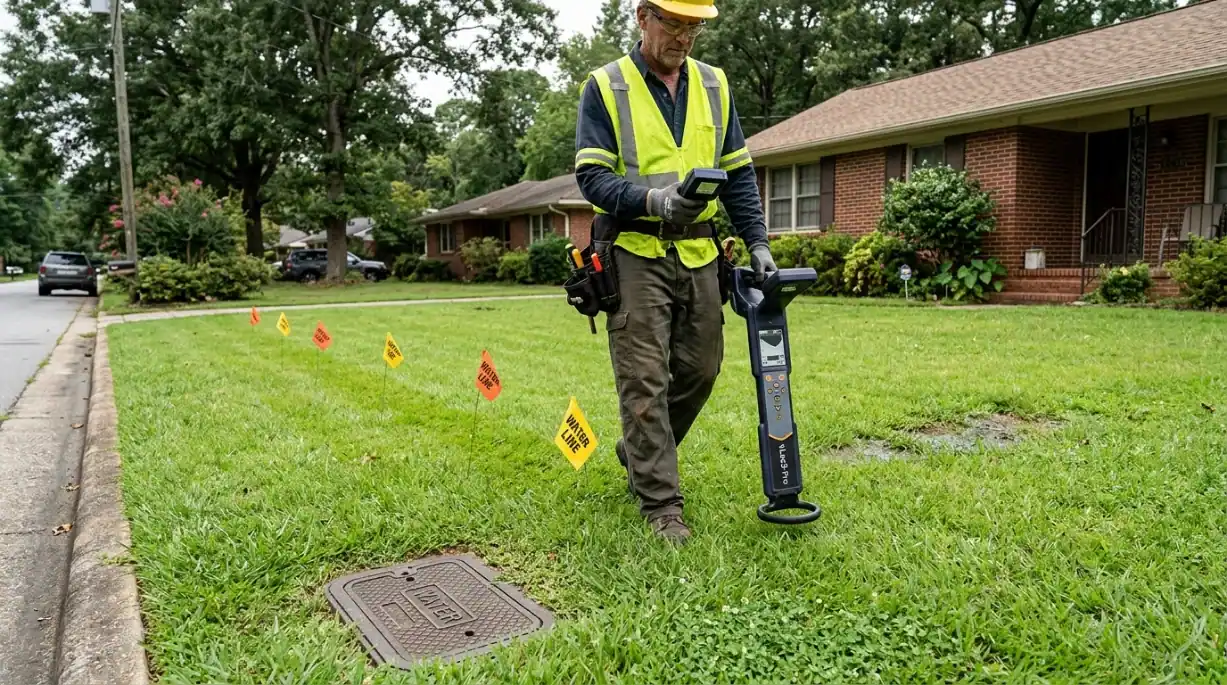
- Trace the route. A line locator maps the buried pipe. Older Marietta properties frequently have a service line that does not run where anyone expects.
- Correlate the sound. Sensors at two accessible points on the line, typically the meter and a hose bib, measure the time difference of the leak noise travelling in each direction, calculating the distance to the leak.
- Confirm with ground microphones. Listening at the surface along the calculated position narrows it to a small dig area.
Repair, reroute or replace
A single break in an otherwise sound line can be dug and repaired. But if the line is galvanised steel, early polybutylene, or has already failed once, replacement usually makes more sense, and a new line can often be pulled in without trenching the entire yard. Age, material and the number of previous failures decide it.
The bill keeps running. A service line leak does not get better on its own and produces no warning symptoms to prompt action. Every day it runs adds to a bill that a utility leak credit will only partially offset.
Frequently asked questions
How do I know if my water service line is leaking?
Close the main shut-off valve where the water enters the house, then watch the meter. If it still turns, water is escaping between the meter and that valve, the buried service line. Supporting signs are a soggy or unusually green strip of lawn, water in the meter box, or water surfacing at the kerb.
Who is responsible for the water line from the meter to the house?
The homeowner. The utility maintains the main and the meter; everything on the house side of the meter is the property owner's responsibility, including the buried service line, the irrigation tee and all interior plumbing.
Can an underground water leak be found without digging up the yard?
Yes. Line tracing maps where the pipe runs, and leak correlation uses sensors at two accessible points to calculate the distance to the leak from the time the sound takes to travel each way. Ground microphones then confirm it at the surface, so only a small area is excavated.
Why is there no water showing if the line is leaking?
Because it drains into the soil. Depending on depth, soil type and how the ground slopes, water can travel a long way before surfacing, or never surface at all. That is exactly why these leaks run for months and produce very large bills.
Should I repair the service line or replace it?
A single break in sound pipe can be repaired. If the line is galvanised steel, early polybutylene, or has already failed before, replacement is usually the better economics, and a replacement line can often be pulled in without trenching the whole yard.
Does a service line leak qualify for a Cobb County leak credit?
Yes, it is a classic qualifying plumbing failure, provided you document the repair. Cobb County allows a partial credit once per rolling 12-month period across no more than two affected months, and requires a repair receipt, parts receipt, or a letter explaining what was done.