
Last reviewed and updated: 2026-09-20
A slab leak is a break in a water line running through or beneath your concrete foundation. In Marietta it most often affects homes built between the 1960s and 1980s, where copper supply lines were run under the slab and have corroded from the outside in. It is located without demolition by isolating and pressure-testing the lines, tracing where the pipe actually runs, then using acoustic ground microphones and thermal imaging to narrow the leak to within inches before anything is opened.
Warning signs of a slab leak
- A warm or hot patch on the floor: the classic sign of a hot water line failing under the slab
- The sound of running water with every fixture off: pressurised water escaping continuously
- A water bill climbing steadily rather than spiking all at once
- Damp carpet, buckling hardwood or cracked tile with no visible source above
- A drop in water pressure as volume is lost before it reaches the fixtures
- A musty smell in one area of the house
- New hairline cracks in the slab, walls or door frames as moisture moves the soil beneath
Why slab leaks are common in Marietta
Slab leaks are one strand of leak detection in Marietta, GA; the other common outdoor strand is a buried water service line leak, which the meter test separates from this one in about twenty minutes.
Three things line up in this area. First, the pipe era: a large share of Marietta and Cobb County housing went up between the 1960s and 1980s, when copper supply lines were commonly run under the slab. Copper in direct contact with concrete and soil corrodes slowly from the outside, and the resulting pinhole can run for months undetected, which is why it usually shows up first as a water bill that keeps climbing rather than as visible water.
Second, Georgia red clay. It expands when wet and contracts when dry, and that seasonal movement puts repeated stress on anything cast into or running beneath a foundation. It is the same ground movement behind the failures we see along Sandy Plains and across East Cobb.
Third, water chemistry and pressure. Sustained pressure above roughly 80 psi accelerates pinhole formation in ageing copper, and abrasion where a line rubs against the slab edge does the rest.
How a slab leak is actually located
- Confirm the leak exists. The meter test establishes that water is escaping. Nothing else happens until that is settled.
- Isolate hot from cold. Shutting off the water heater supply and watching the meter tells you which side is leaking, which immediately halves the search area.
- Pressure test the suspect line. Capping and pressurising a section with a gauge proves which run is losing and roughly how fast.
- Trace the pipe route. A line locator maps where the pipe genuinely runs under the slab, which is often not where anyone assumed.
- Listen through the concrete. Acoustic ground microphones pick up the high-frequency hiss of pressurised water escaping. The technician works along the traced route until the signal peaks.
- Confirm with a second method. Thermal imaging shows the temperature anomaly from a hot-side leak; tracer gas finds leaks too small or too quiet to hear. Only then is the spot marked.
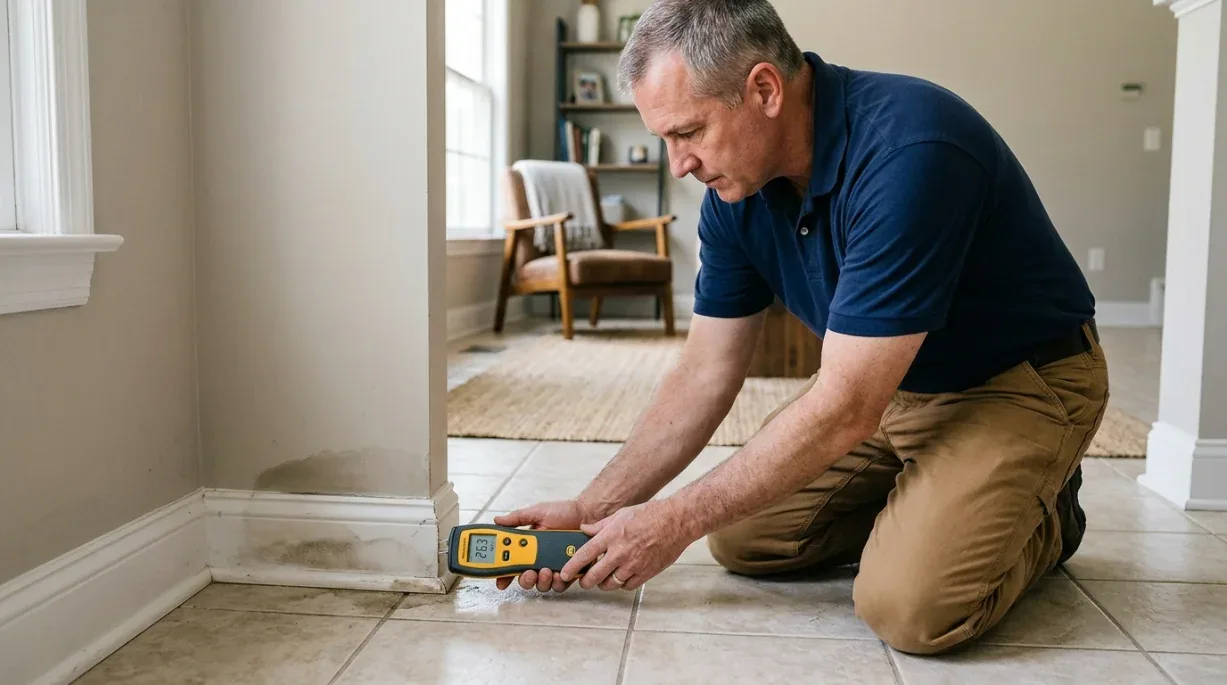
Repair options once it is found
| Option | When it makes sense | Trade-off |
|---|---|---|
| Spot repair | A single failure in otherwise sound pipe, with reasonable access | Cheapest, but does nothing for the rest of an ageing system |
| Reroute above the slab | The failed run can be abandoned and re-run through walls or the attic | Avoids cutting concrete; involves drywall work instead |
| Partial repipe | One zone has failed repeatedly | Middle ground on cost and disruption |
| Whole-home repipe | Polybutylene, or copper that has already failed more than once under the slab | Highest cost, but ends the cycle |
A second slab leak changes the conversation. One failure can be bad luck. A second in the same system usually means the pipe material itself has reached the end of its life, and patching individual points becomes a recurring expense.
What not to do
- Do not start cutting concrete to look. Exploratory demolition in the wrong place costs more than the diagnostic that would have avoided it, and the leak is still unfound.
- Do not ignore a warm floor patch. It is water running continuously under your foundation, and the bill accrues every day.
- Do not close out the repair without documentation. You need it for a Cobb County leak credit and for any insurance claim.
Frequently asked questions
What are the signs of a slab leak?
A warm or hot patch on the floor, the sound of running water when everything is off, a water bill climbing steadily, damp carpet or buckling flooring with no visible source, a drop in water pressure, a musty smell in one area, and new hairline cracks in the slab or walls.
Can a slab leak be found without breaking the floor?
Yes, that is the point of professional detection. Pressure testing identifies which line is losing, a locator traces where the pipe runs, acoustic ground microphones hear the escaping water through the concrete, and thermal imaging or tracer gas confirms the spot. Only a small area is then opened.
Why are slab leaks common in Marietta homes?
A large part of Marietta's housing stock was built between the 1960s and 1980s with copper supply lines run under the slab. Copper in contact with concrete and soil corrodes over decades, and Georgia's expansive red clay adds seasonal ground movement that stresses the pipe further.
How long does a slab leak take to find?
Most residential slab leak inspections take one to three hours. Large homes with several isolation zones, unknown pipe routing, difficult flooring or significant background noise take longer.
Is a slab leak an emergency?
It is urgent rather than a same-minute emergency. Water running continuously under a foundation damages flooring, feeds mould and can move the soil beneath the slab, and the water bill accrues daily. Closing the main shut-off valve stops the loss until it can be located.
Should I repair the leak or repipe the house?
One failure in otherwise sound pipe usually justifies a spot repair or a reroute. A second failure in the same system, or polybutylene pipe anywhere in the house, shifts the economics towards a partial or full repipe, because patching a failing material becomes a recurring expense.
Will my insurance cover a slab leak?
Often the resulting damage, access and restoration are covered, while the pipe repair itself may be treated as maintenance. Under-slab coverage was withdrawn by many carriers and later reintroduced as optional limited products, so it depends on your specific policy. Earth movement and gradual deterioration are the exclusions that most often apply.
Does a slab leak qualify for a Cobb County water bill credit?
Yes, as a plumbing failure, provided you can document the repair. Cobb County allows a partial credit once per rolling 12-month period across no more than two affected months, and requires a repair receipt, a parts receipt, or a letter explaining what was done.